Introduction
I wanted to make a lesson plan that utilized culturally responsive teaching practices like respecting and reinforcing the students’ cultures by having lessons that they found culturally relevant and that allowed them to share their cultural background, seeing an opportunity to invite the students’ family to share in their child’s learning, and to deconstruct cultural biasis by allowing the students to share their holiday traditions in a safe space where effective communitcation is modelled and encouraged (Burnham, 2024). I also wanted to implement the four essential R’s into the lesson, which are “routine, ritual, repetition, [and] replication” (ACE, 2025). For routine, I incorporated many procedures that I use in my class. For the ritual, I made sure to include storytime in the lesson because it is also something that my class often does. For repetition, I made sure to co-create anchor charts with the students that can be referred to often. For replication, I designed the lessons to include a cumulative activity where students become teachers by creating holiday tradition videos that educate the class and their families about the holiday traditions they have chosen to feature in their videos. I have also included spatial-kinesthetic activities, such as creating props for the holiday tradition videos and using iPads to produce them, to engage the boys in my class by incorporating their natural strengths (ACE, 2025). Finally, I wanted to specifically incorporate something that has been shown to help younger students: peer-assisted learning strategies (ACE, 2025). I wanted to ensure that I found an opportunity in the lessons to invite fourth graders to assist the first graders during a part of the lesson where they needed extra help. I have conducted lessons with kindergarteners making stop-motion videos, and the videos usually turn out to be a little rough. Many students lack the knowledge of how to utilize camera angles and movement in their videos effectively. I think it would be great if the fourth graders could assist them, as it would make their videos much bette
Table 1
UDL Lesson Plan
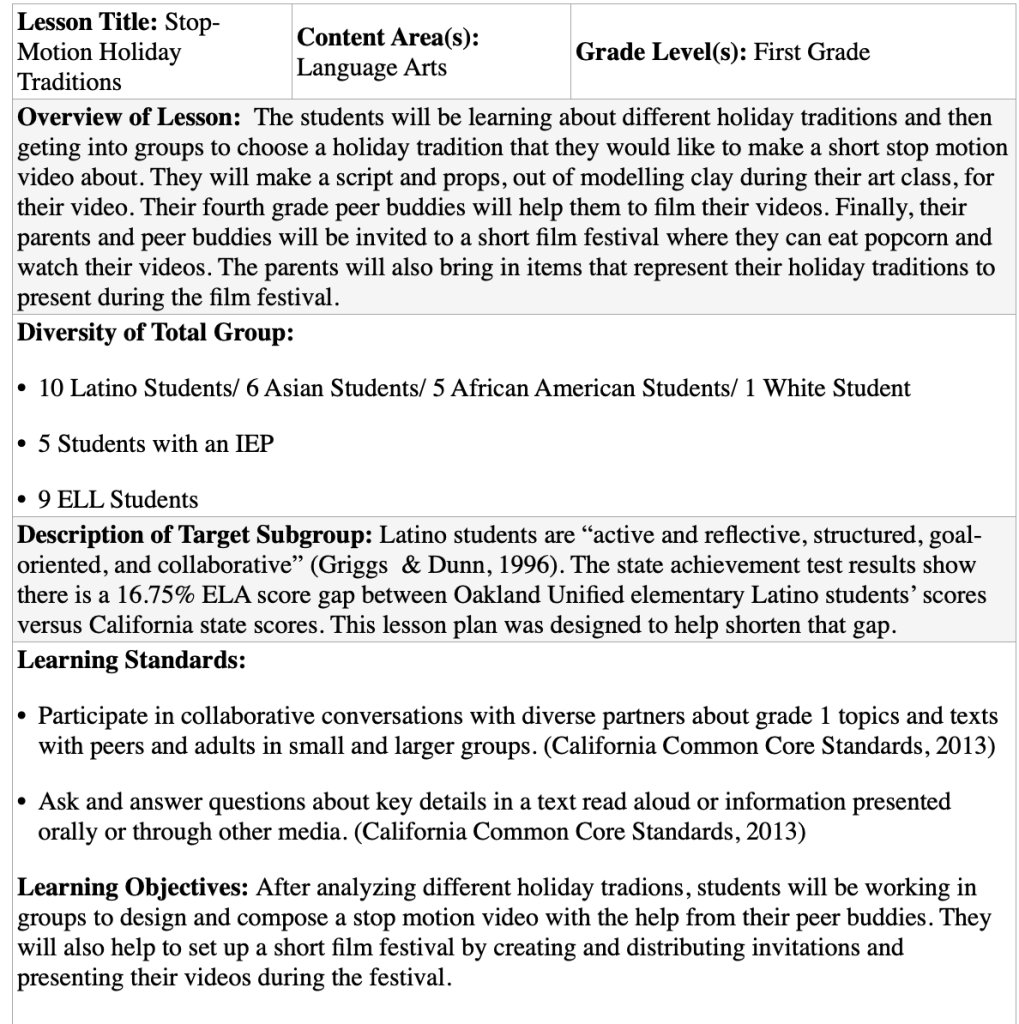
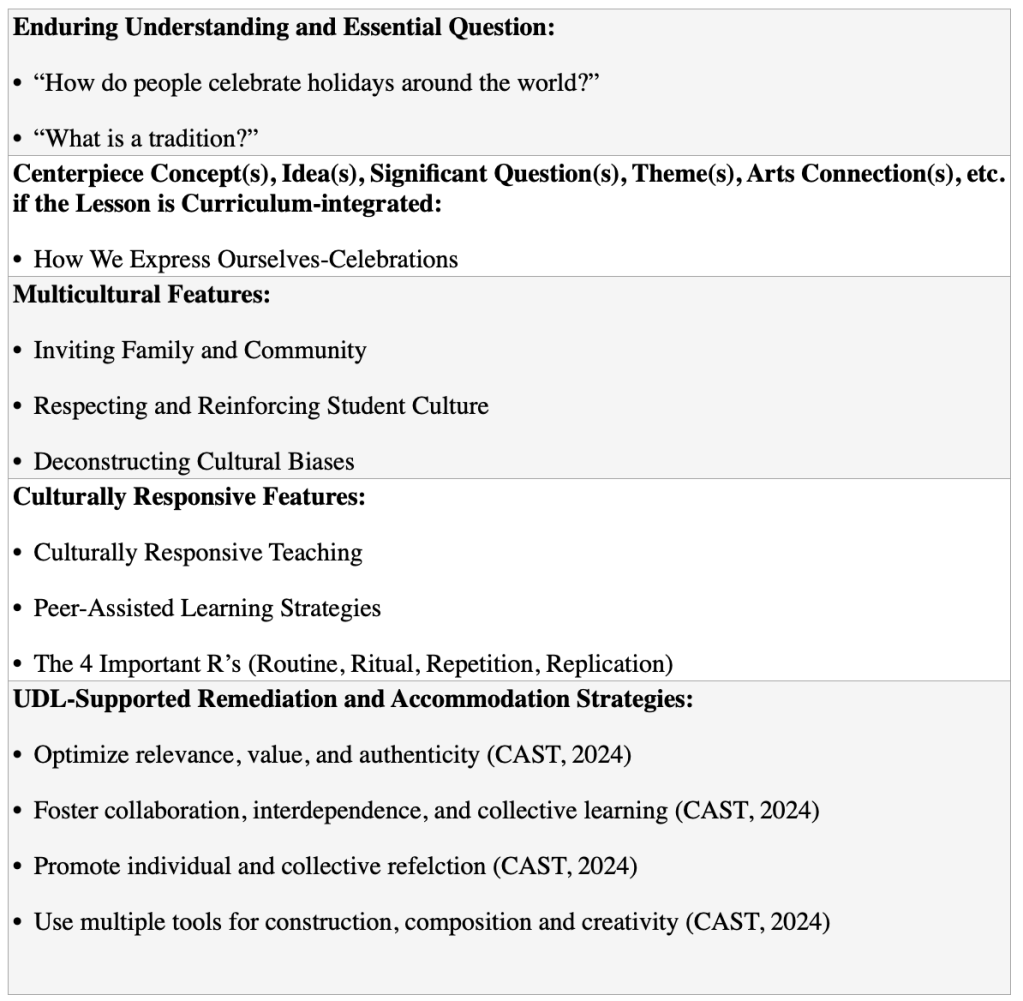

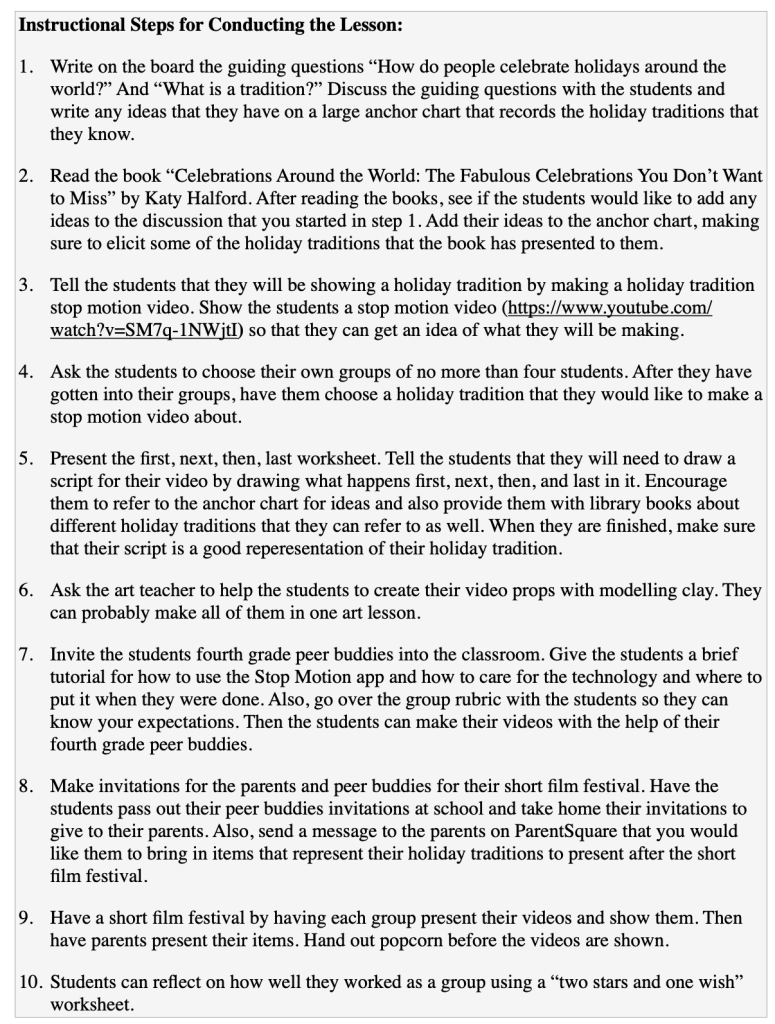
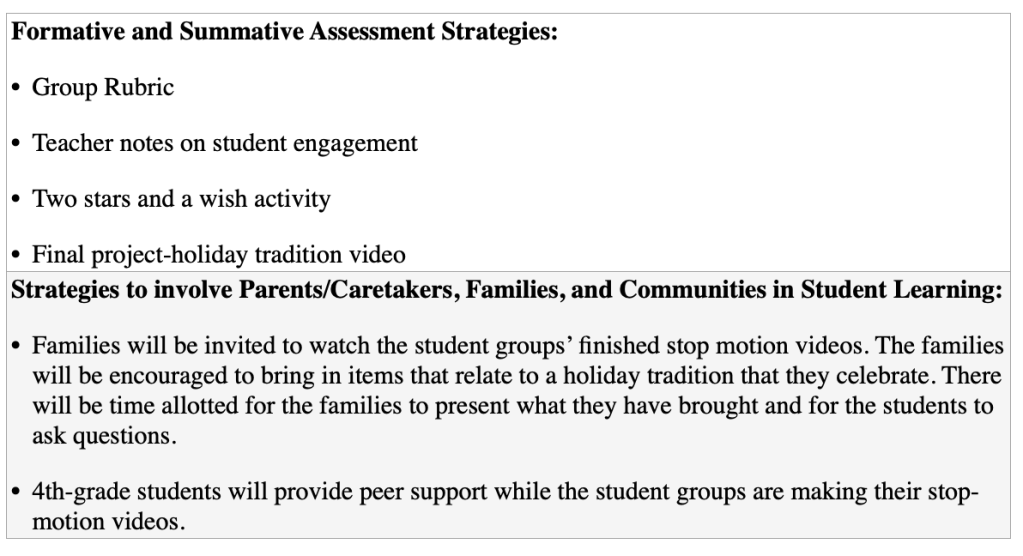
Table 2
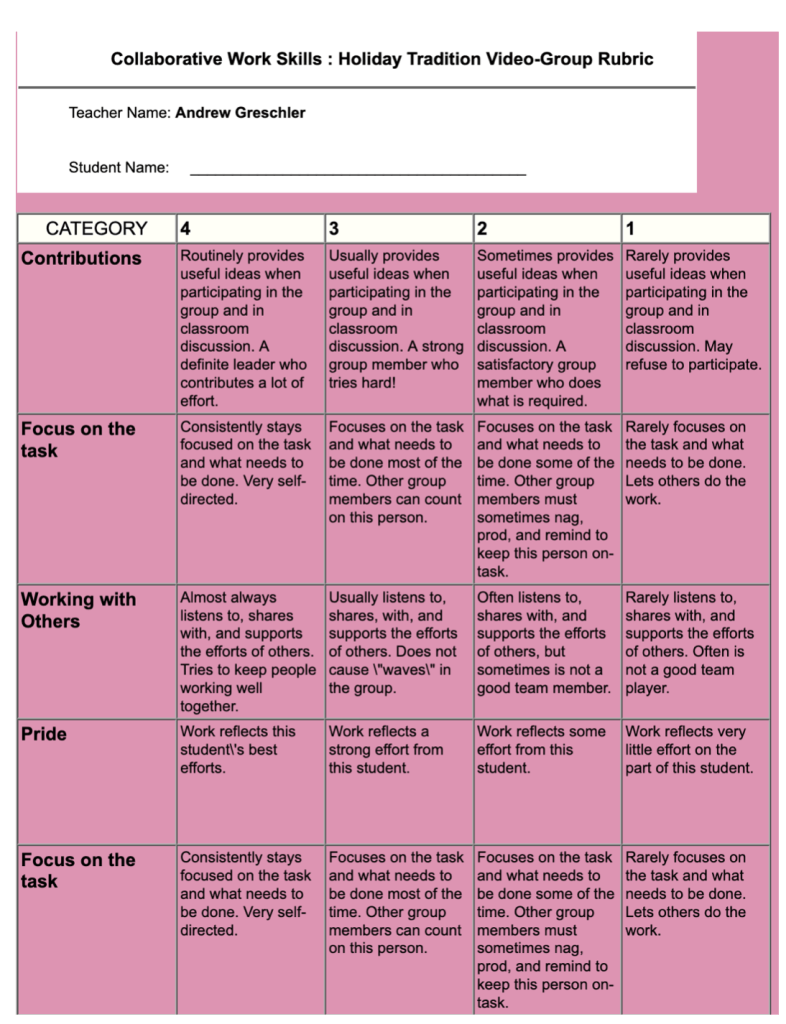
Group Rubric
Conclusion
This was a fun lesson to design because I got to imagine all of the families’ and students’ smiling faces when they got to eat popcorn together and share their holiday traditions through videos and cultural artifacts. I could not have designed such an effective lesson plan without implementing the UDL guidelines of optimizing “relevance, value and authenticity,” fostering “collaboration, interdependence and collective learning,” promoting “individual and collective reflection,” [and] using “multiple tools for construction, composition and creativity” (CAST, 2024). I optimized “relevance, value, and authenticity” by incorporating culturally relevant practices into my lesson plan, which allowed students to choose a holiday tradition that either reflected their cultural background or one that interested them. I fostered “collaboration, interdependence, and collective learning” by ensuring that my lesson plan was primarily based on group activities and discussions. There are very few instances of teacher talk time, and these instances are mainly used to facilitate group learning and discussions. I promoted “individual and collective reflection” by incorporating a group rubric that was presented and explained to the students and by incorporating a reflection stage at the end of the lesson plan that asked the students to write down two things they did well and one thing that they would like to improve for their next group activity. Finally, I utilized “multiple tools for construction, composition, and creativity” by ensuring that students had a wide range of resources and tools to compose a product that reflected their creativity.
References
Burnham, K. (2024, July 1). Culturally Responsive Teaching: 5 Strategies for Educators. Northeastern University Graduate Programs. https://graduate.northeastern.edu/knowledge-hub/culturally-responsive-teaching-strategies/
California Assessment of Student Performance and Progress (CAASPP) 2015 Results. (n.d.). Retrieved November 22, 2025, from https://west.edtrust.org/wp-content/uploads/2015/09/ETW-CAASPP-Results-analysis.pdf
California Department of Education. (2013). California Common Core State Standards. https://www.cde.ca.gov/be/st/ss/documents/finalelaccssstandards.pdf
CAST. (2024). The UDL Guidelines. CAST. https://udlguidelines.cast.org/
Culturally and Linguistically Responsive Teaching – Professional Learning (CA Dept of Education). (2025, June 5). http://Www.cde.ca.gov. https://www.cde.ca.gov/ci/pl/responsiveteaching.asp
Griggs, S., & Dunn, R. (1996). Hispanic-American Students and Learning Style. ERIC Digest. In ERIC. https://eric.ed.gov/?id=ED393607
PYP Units of Inquiry. (n.d.). http://Www.lisbahamas.com. https://www.lisbahamas.com/apps/pages/index.jsp?uREC_ID=1055075&type=d&pREC_ID=1365865
Singhal, M., & Gulati, S. (2020, August 31). Five Essential Strategies to Embrace Culturally Responsive Teaching | Faculty Focus. Faculty Focus | Higher Ed
Teaching & Learning; Faculty Focus. https://www.facultyfocus.com/articles/equality-inclusion-and-diversity/five-essential-strategies-to-embrace-culturally-responsive-teaching/
Utica University. (2020). Bloom’s Taxonomy of Measurable Verbs. Utica University. https://www.utica.edu/academic/Assessment/new/Blooms%20Taxonomy%20-%20Best.pdf
 Educational Reflections
Leave a comment