Introduction
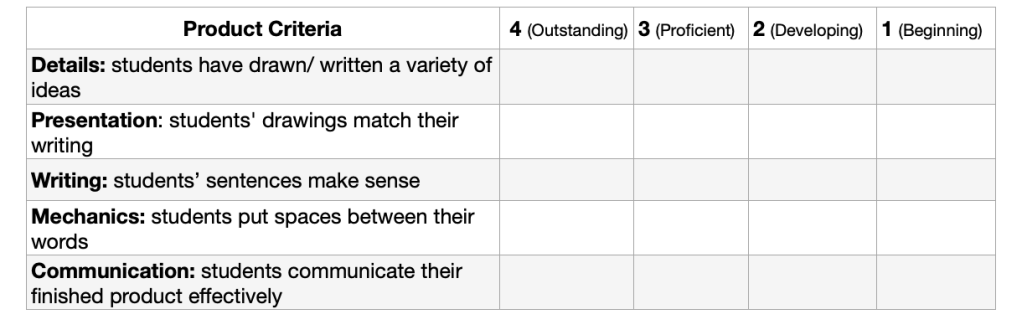
One of the most important aspects of developing formative and summative assessments for kindergarteners is ensuring they are developmentally appropriate. The assessments that I have designed will be implemented during my kindergarten class’s first unit. This means these assessments may be the first my students have ever done. With this in mind, I designed a formative assessment that used clear instructions and included many visuals to promote higher-order analysis skills (Jovanovska, 2018). I have also found that visuals make learning more accessible to a wider variety of kindergarten students. The formative assessments are a good demonstration of my students’ knowledge and skills. They also prepare students to perform better on the summative assessment by testing the knowledge they need to succeed. For example, the formative assessments ask the students to recall some of the cultural characteristics that they will be assessed on during the summative assessment. The summative assessment is the unit’s end product. It is designed to allow students to record and present the knowledge they have learned during the unit and to evaluate it against standards (Disxson & Worrell, 2016). The summative assessment is also accessible to students, as a large portion of their final grade is based on drawing and dictation knowledge. It can also be challenging, because it allows higher-achieving students to write up to three sentences. I am looking forward to seeing their end product because it will be great to see all that they have learned during the unit reflected in it.
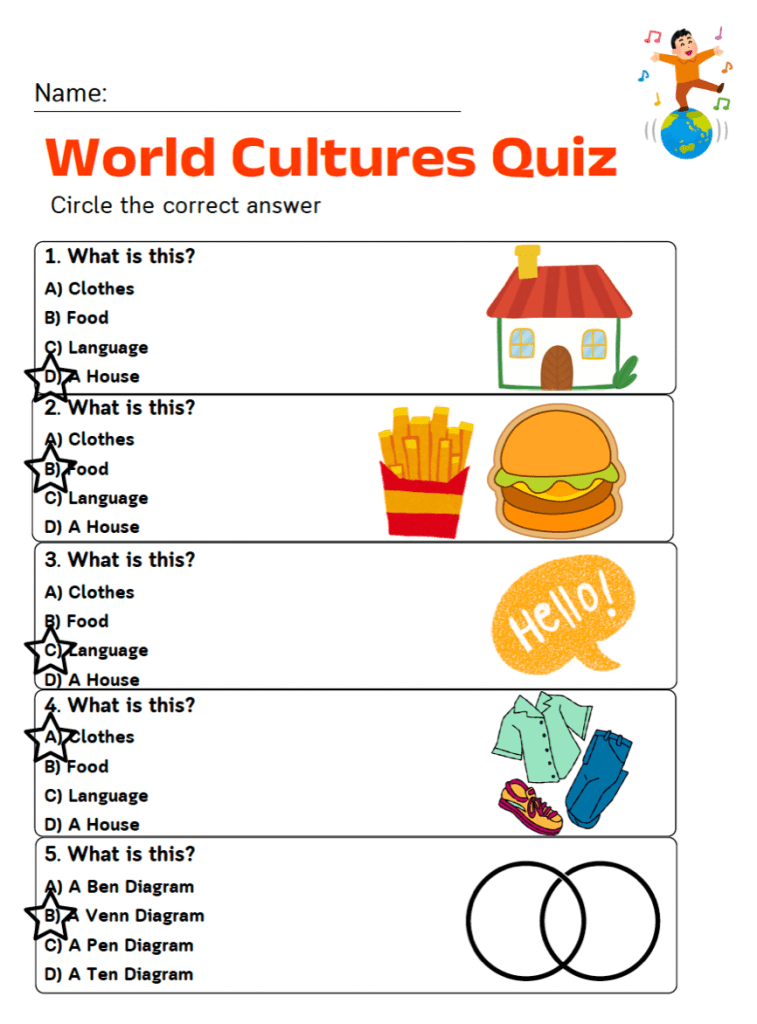
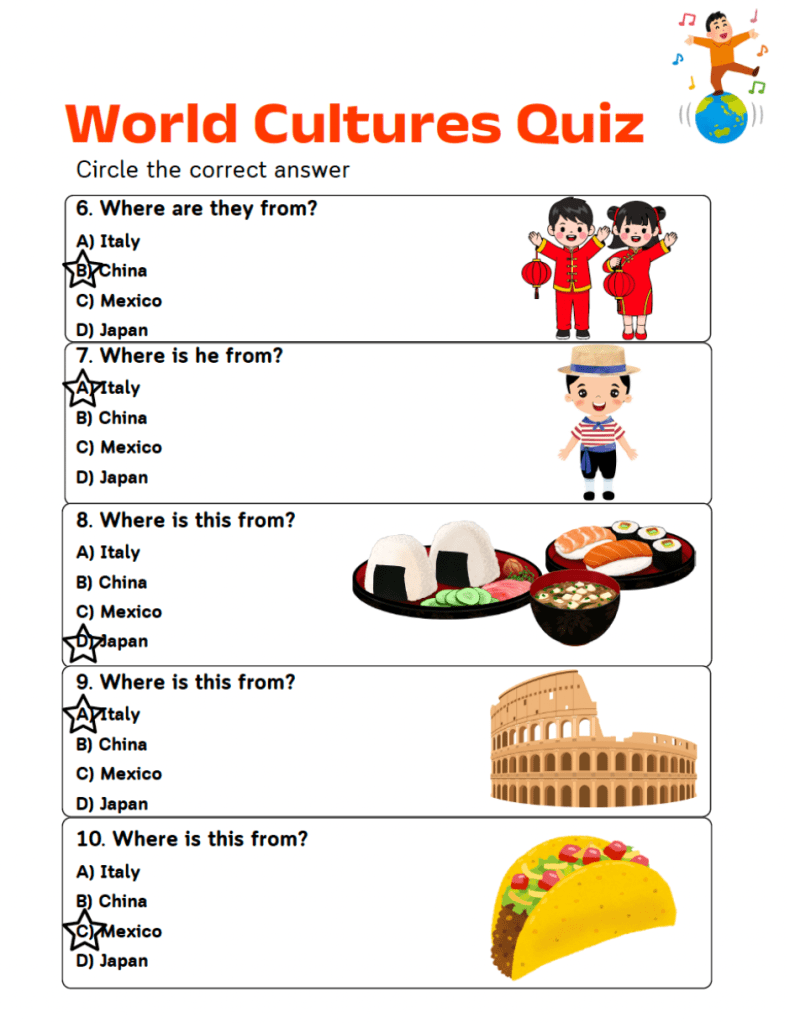
Figures 1 and 2
Multiple-Choice Test
Pre-Administration Item Analysis
I created the multiple-choice test with my kindergarteners in mind. This will be the first multiple-choice test that they take in kindergarten. So, for many students, it may be their first multiple-choice test. When creating the multiple-choice test, I made sure to use consistent, concise language that is appropriate to their grade level. I need to use concise language while still testing higher-order thinking. Originally, questions six and seven had the exact wording as questions eight, nine, and ten. I decided to give the students a greater challenge by modifying the wording and having them analyze and interpret more complex visuals. This can help them to improve their critical thinking skills (Jovanovska, 2018)
Figure 3
Formative Assessment
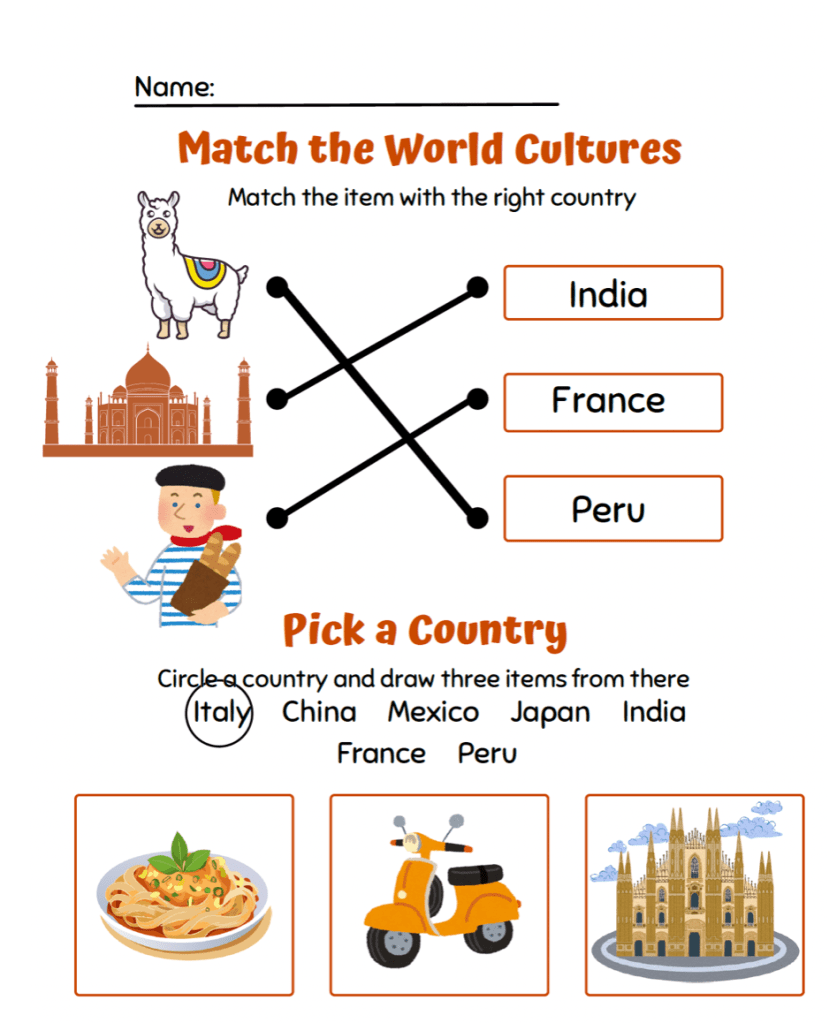
Figure 4
Description of Performance Task

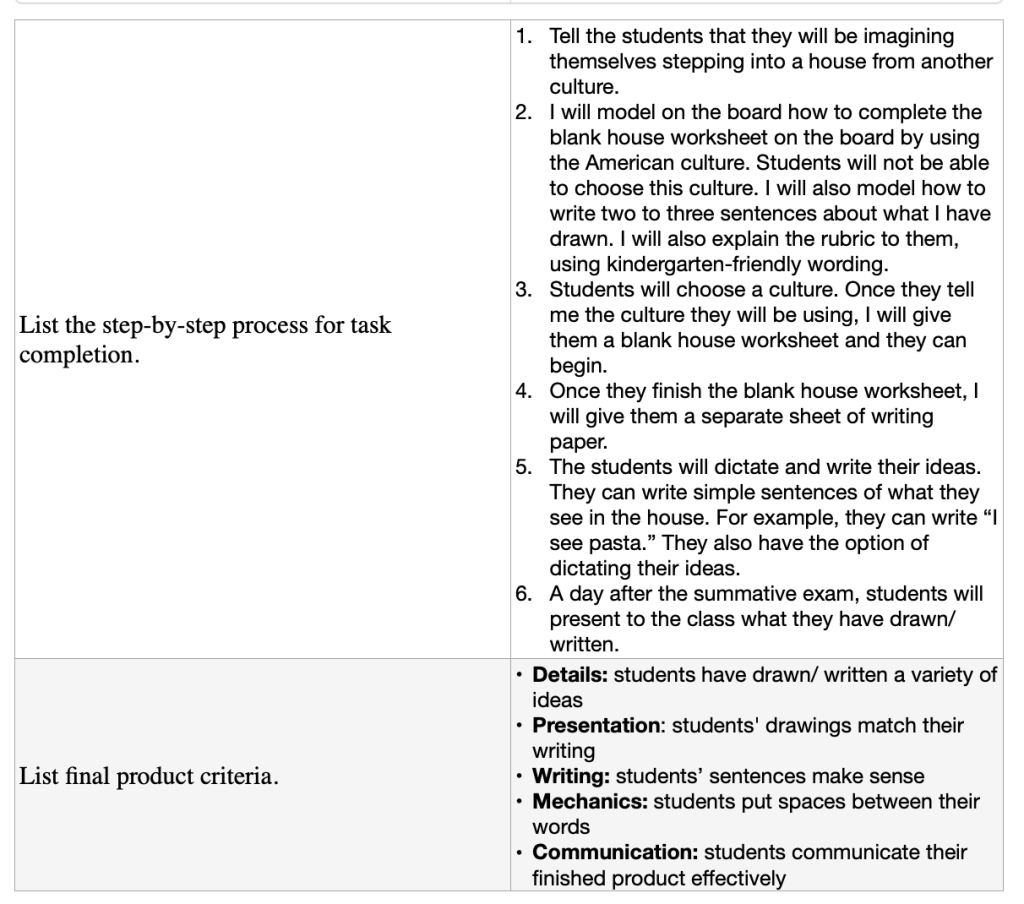
Figure 5
Holistic Rubric
Conclusion
When I imagine myself looking at my students’ finished products, I see details that have come through weeks of inquiry into culture. I see my students’ details, which let me know they have become more globally aware and more open to other cultures. Their finished products will be the perfect decorations for the class’s end-of-unit potluck. During the potluck, we will invite every student’s family to bring in a dish that best represents their culture. After spending weeks viewing videos, art, and artifacts from other cultures, they will finally get to taste the flavors of those cultures. During the potluck, the students will also be able to present their finished products to their families. I am sure their families will be proud of what they have accomplished. This summative assessment is designed to demonstrate learning, growth, and cultural awareness. It is empowering to go from designing summative assessments that were fill-in-the-blank, multiple choice, and matching to designing ones that actually involve students and their families in cultural dialogues.
References
California Department of Education. (2013). California Common Core State Standards. https://www.cde.ca.gov/be/st/ss/documents/finalelaccssstandards.pdf
Dixson, D. D., & Worrell, F. C. (2016). Formative and Summative Assessment in the Classroom. Theory Into Practice, 55(2), 153–159. https://doi.org/10.1080/00405841.2016.1148989
Jovanovska, J. (2018). Designing effective multiple-choice questions for assessing learning outcomes. Infotheca: Journal for Digital Humanities, 18(1), 25–42. https://doi.org/10.18485/infotheca.2018.18.1.2
 Educational Reflections
Leave a comment