Creating classrooms that have a positive climate where students can achieve academically is not an easy task. The first step to achieving a successful classroom is to create a PBSS system at a school. To set-up a PBSS system a school must make sure there is:
(1) identification of important schoolwide outcomes for student learning and behavior; (2) development of organizational systems to support the implementation and sustainability of SWPBS practices; (3) implementation of evidence based practices to create a positive social climate and learning environment; and (4) use of data to monitor progress toward global schoolwide outcomes and facilitate effective data-based decisions (Sugai & Horner, 2006, as cited in Flannery et al., 2013).
As a teacher I have the most experience in implementing evidence-based practices. There are many evidence-based practices that can be equally useful, these include: “classroom management, teaching expectations, rules & procedures, classroom and school rules, classroom physical arrangements, appropriate curriculum and student engagements, characteristics of instruction, positive acknowledgement, building relationships, [and] social-emotional learning” (Skiba et al., 2016). The two evidence-based practices that I have found to be the most helpful for creating successful classrooms are classroom rules and building relationships.
Classroom Rules
When students start their fall semester, establishing classroom rules is one of the first evidence-based practices that needs to be implemented. They are important because they “function as an explicit outline for students of classroom expectations” (Jones & Jones, 2012, as cited by Skiba et al., 2016). I have found that it is crucial that classroom rules are stated positively, are clear, and modelled so that all of the students understand them. Students will also be more likely to follow them if they come up with them themselves. Students “place greater value on being actively involved in decision-making” (Flannery et al., 2013). A good way to set up clear, positive, modeled and student-centered classroom rules is to use Responsive Classroom. For students to take ownership of their classroom rules, Responsive Classroom suggests “talking to your class about your hopes for the coming year and ask them to articulate their own goals for the school year.” (Responsive Classroom, 2023). Ultimately, throughout the Responsive Classroom rule making process, students start to see that the rules that they create will help them to attain their academic and personal goals. Therefore, they start to see that following classroom rules is crucial for their academic, social and personal success.
Building Relationships
As far as evidence-based practices go, building relationships is the very first that needs to be utilized. Building relationships is important because “classrooms with quality teacher-student relationships have fewer classroom behavior problems and better academic performance” (O’Connor et al., 2011, as cited by Skiba et al., 2016). It has also been found that building relationship programs, like youth development programs, “have been shown to impact…life satisfaction and problem behaviors like drug use” (Taylor et al., 2017, as cited by Acosta et al., 2019). It’s important to note that building relationships does not just help students to be successful in their classroom, it also helps them to be successful outside of it too.
Every day I start building relationships with my students during our morning circle time. That is just one example of how a teacher can build relationships with their students. One thing a teacher needs to remember is to “take an intentional approach to ensure all students and families feel heard and seen in their classroom.” (OSSE). Building relationships is not always an easy task but it is a worthwhile endeavor for all of the benefits that it brings.
Figure 1
Classroom Rules Vs. Building Relationships
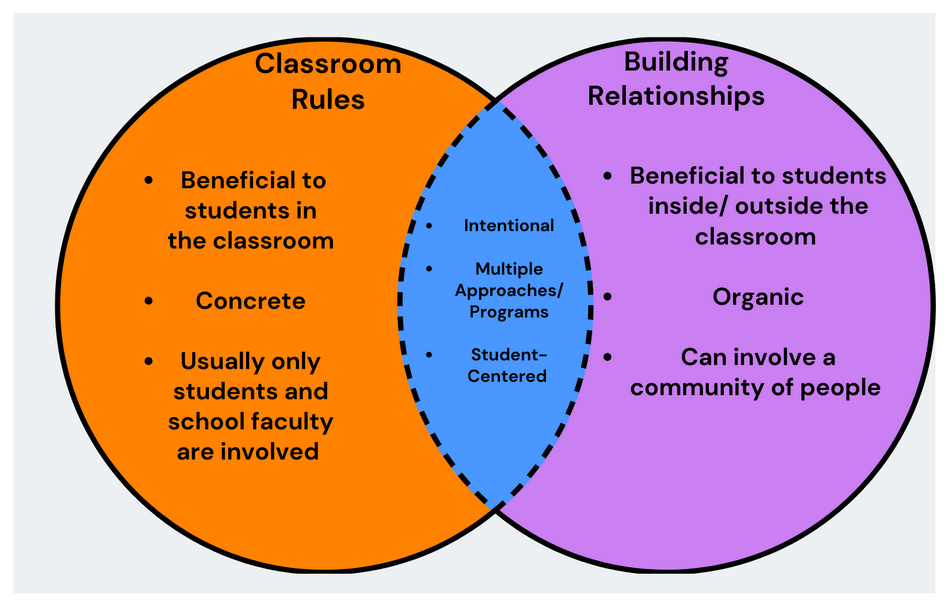
When comparing classroom rules and building relationships it is important to note that they both require evidence-based steps to implement. For example, if a teacher is using Responsive Classroom then they could guide their students to create classroom rules by having them use their goals to think of the classroom rules that they would like to create. A teacher could also use Responsive Classroom to build relationships through daily morning meetings. The difference is that classroom rules are more concrete, the rules are clearly stated, modelled and referred to often throughout the school year. Building relationships is more organic, every student is different and therefore a teacher relationship with one student can look different than another. Finally, classroom rules are mainly centered in the classroom and therefore only school faculty and students are involved. Building relationships can be extended to a student’s family and to outside community members. Ideally, they are both done with intention and they need to be student-centered in order for them to be the most effective.
Conclusion
I chose the evidence-based practices of classroom rules and building relationships because I believe that they are fundamental to building a positive climate where students can achieve academically. Classroom rules can help guide students to achieving their goals by reminding them of the expectations that a teacher has and that they should have for themselves. Building relationships helps to build a positive classroom because it can greatly enhance a student’s behavior and relationships with their peers, and that change can make a better classroom environment. It’s no surprise that one study found, “Negative student behaviors decreased as a result of the implementation of Morning Meeting. Analysis of the data collected suggested the positive impacts Morning Meeting has on student behavior and peer relationships. Positive student behavior and peer relationships create a positive classroom community” (Dooley, 2019). I believe that every successful classroom has effective student created classroom rules and a strong culture of building relationships as its foundation.
References
Dooley, A. (2019). Morning meeting: An examination of its effect on student morning meeting: An examination of its effect on student behavior and peer relationships behavior and peer relationships. https://nwcommons.nwciowa.edu/ cgi/viewcontent.cgi? article=1143&context=education_masters
Everyday Rules That Work! | Responsive Classroom. (2017, February 23). Responsive Classroom. https://www.responsiveclassroom.org/everyday-rules-that-work/
Flannery, K. B., Frank, J. L., McGrath Kato, M., Doren, B., & Fenning, P. (2013). Implementing Schoolwide Positive Behavior Support in High School Settings: Analysis of Eight High Schools. High School Journal, 96(4), 267–282. https://doi.org/10.1353/ hsj.2013.0015
Office of the State Superintendent of Education. (n.d.). Relationship-Building strategies for the classroom. https://osse.dc.gov/sites/default/files/dc/sites/osse/page_content/ attachments/Relationhip_Building_Toolkit.pdf
Skiba, R., Ormiston, H., Martinez, S., & Cummings, J. (2016). Teaching the Social Curriculum: Classroom Management as Behavioral Instruction. Theory Into Practice, 55(2), 120–128. https://doi.org/10.1080/00405841.2016.1148990
 Educational Reflections
Leave a comment